
By David Fox
Media and entertainment storage is no longer just about capacity. It is about control, visibility, compliance, and workflow integration. Editors expect immediate access to the right assets. Producers expect security. Studios expect encryption. Finance expects cost transparency.
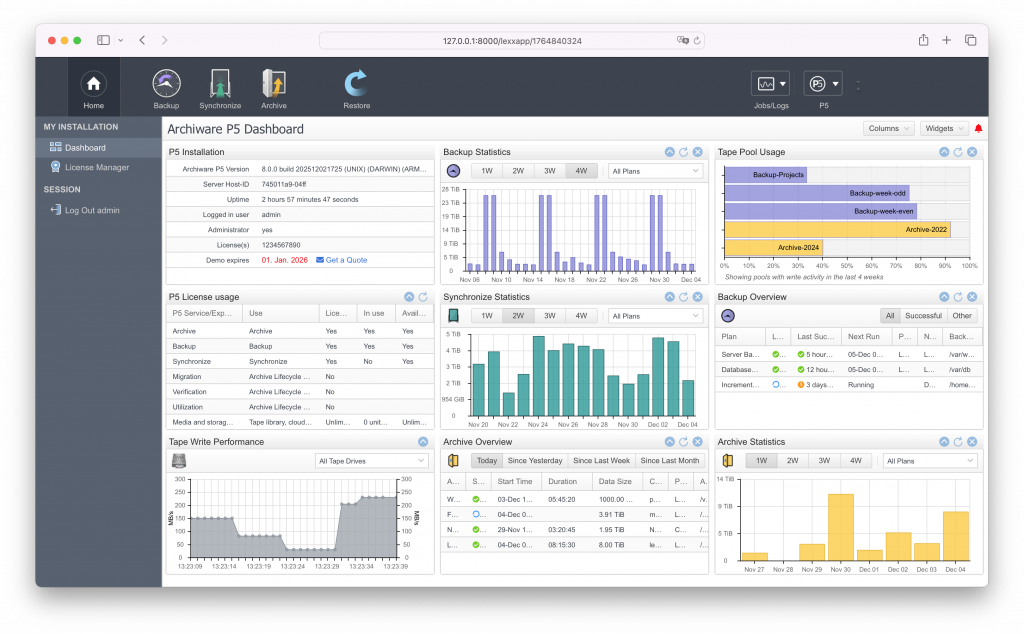
With Version 8, Archiware P5 takes a significant step forward in aligning archive and backup infrastructure with the operational realities of modern production environments. The focus is clear: better workflow tools, deeper visibility into archived content, stronger governance, and more flexible cloud integration.
Below is a closer look at the first five major features introduced in P5 Version 8.
1. Project Restore: Bringing Editorial Context Back to the Archive
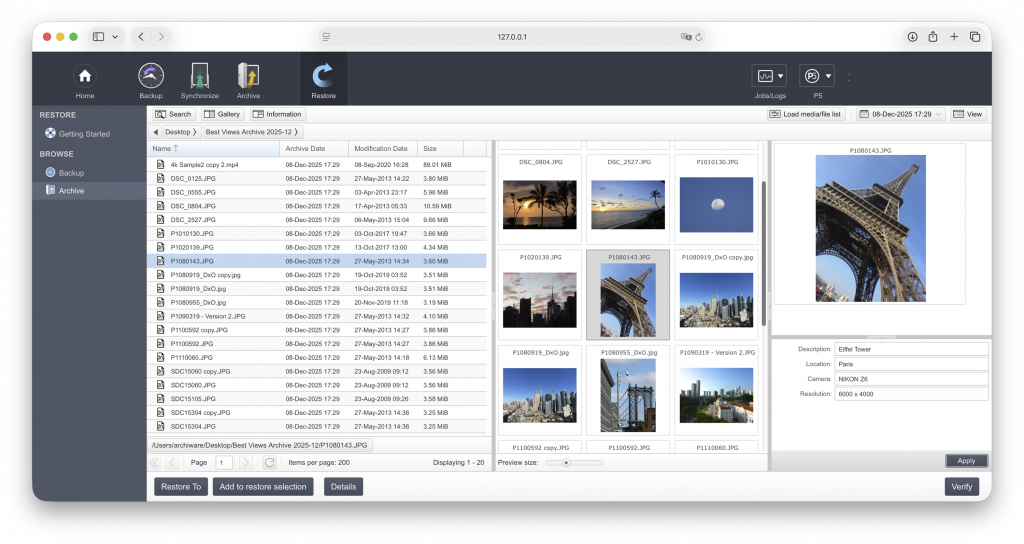
One of the most powerful additions in Version 8 is Project Restore.
Editors work in timelines, not folder trees. Archive administrators think in storage pools and tape volumes. Project Restore bridges that gap.
P5 Archive can now import project files such as EDL, OTIO, FCPXML and ALE and automatically restore all referenced media. This supports offline to online conform workflows and archive recovery directly from editorial exports.
Key capabilities include:
- Smart Search that finds media even if file paths have changed
- Bulk processing of hundreds of references at once
- Preview and selection from multiple versions before restore
In practical terms, this means an editor can export a timeline, drag it into P5, and let the archive locate and restore the exact media required.
For post houses managing multiple shows, seasons, and versions, this is transformative. It reduces restore errors, shortens conform time, and provides much clearer visibility into what is actually stored and retrievable.
2. Archive DLM Utilization: Understanding What Your Archive Really Contains
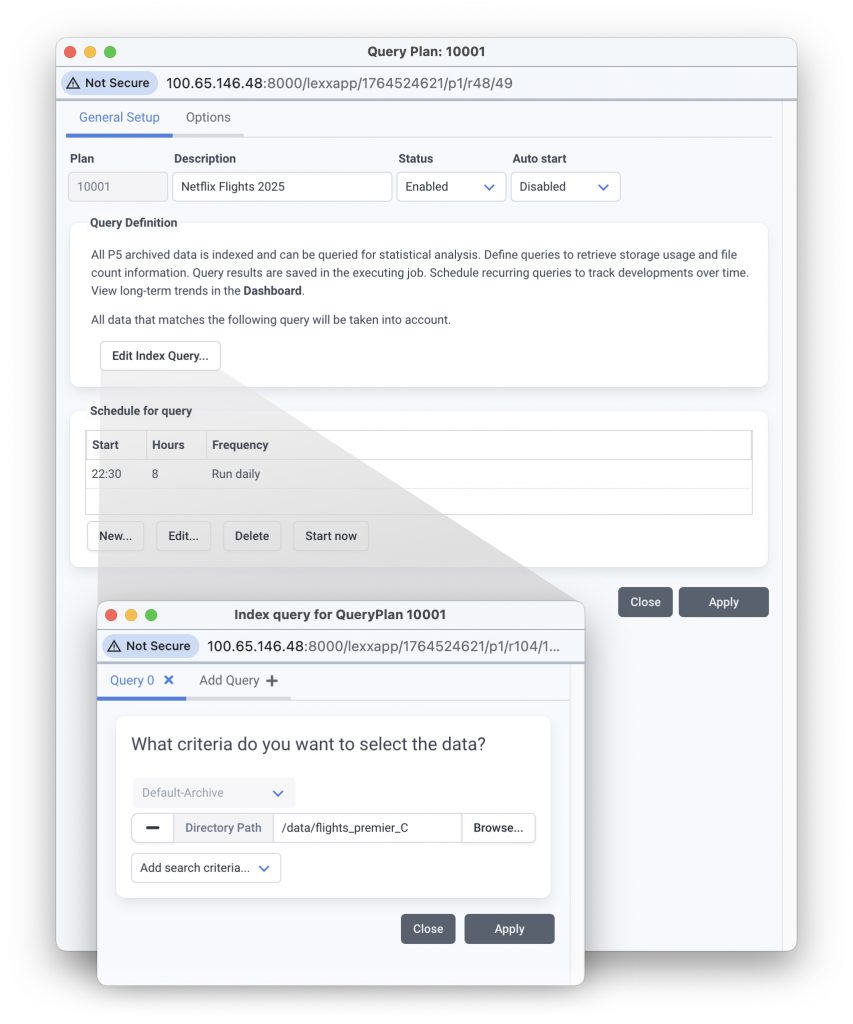
As archives grow, so does the question: what is actually in there, and who is consuming the space? Version 8 extends P5 Archive DLM with query-based storage analysis. Users can now define custom queries to calculate storage usage based on index paths, filenames, or metadata.
This enables:
- Monitoring archive growth over time
- Identifying usage patterns and file distribution
- Scheduled recurring analysis with dashboard visualization
- CSV export for reporting into external systems
For media organizations, this opens up several important operational advantages.
You can calculate storage per show, per client, or per campaign. You can identify which productions are driving growth. You can support internal chargeback models. You can provide transparent reporting to clients.
This moves the archive from being a passive repository to a measurable asset under active management.
For compliance driven industries and cost sensitive broadcasters alike, that visibility is increasingly critical.
3. LTO Hardware Encryption: Meeting Studio Security Requirements
Studios and commissioning bodies are tightening their requirements around data security. Shipping unencrypted tapes is often no longer acceptable.
P5 Version 8 adds support for LTO hardware based AES 256 encryption. Encryption occurs directly in the LTO drive, with zero performance impact.
Key points include:
- Hardware based AES 256 encryption
- Support for both LTFS and P5 Native format tapes
- Protection against unauthorized access if tapes are lost or stolen
Encryption can be enabled per storage pool, and keys should be managed externally to ensure proper governance.
For post production companies delivering masters on LTFS tapes to broadcasters, this feature is increasingly mandatory rather than optional. It provides reassurance to clients while preserving performance and workflow simplicity.
4. Cloud Sync Plans: Object-Level Flexibility When You Need It
Version 8 introduces P5 Cloud Synchronize Plans, enabling scheduled replication between local storage and S3 compatible object storage such as AWS, Azure, Google Cloud, Wasabi and others, including on-premise S3 storage. Replication can run to or from the S3 object storage.
This is a different model from P5 Backup and Archive to Cloud. It creates a true one-to-one copy between filesystem and bucket. That simplicity is what’s needed in specific use-cases.:
- Transparent cloud buckets with native object visibility
- Easier integration with third party workflows
- Operational offsite copies readable without P5
- Distribution of production assets to remote teams
However, it is important to position this correctly. P5 Backup und P5 Archive already write efficiently to S3 object storage using indexed workflows and containerized objects. This architecture avoids one-to-one file parity and dramatically reduces API calls by tracking every file in the Archive or Backup index.
Cloud Sync is not a backup and not an archive in the sense our other modules are. It does not maintain the same indexed intelligence or container optimization used by P5 Archive and Backup. There is a one-to-one relationship between local files and cloud objects, which means more API activity and less optimization for very large file counts.
For media environments, the message is simple. If you want long-term retention, lifecycle management, and optimized cloud performance, P5 Archive or Backup to Cloud is likely the right choice. If you need readable, distributable, object-level parity for operational workflows, P5 Cloud Sync provides that flexibility. It complements the existing architecture rather than replacing it.
5. Selective Data Deletion, Volume Reuse and Secure Erase
Long-term retention is only half of the lifecycle. The other half is controlled deletion.
Version 8 introduces selective deletion directly from the P5 Archive index. Administrators can delete complete projects or directory trees. Deleted data is removed from the index and cannot be restored.
After deletion, P5 recalculates restore-relevant data on each LTO volume, allowing:
- Identification of partially used or fully unreferenced tapes
- Consolidation of fragmented volumes via ‘DLM Migration’
- Erase and re-use or destruction of tapes.
This supports GDPR compliant lifecycle management and cost optimization through volume reuse.
For media companies handling sensitive projects, surveillance content, or legally constrained material, this delivers a complete end to end deletion workflow: logical removal, physical consolidation, and secure destruction.
It also reduces unnecessary tape growth by allowing intelligent recycling of media.
A Unified Theme: Control Across the Data Lifecycle
Taken together, these five features share a common thread. They enhance control over:
- how cloud copies are structured and consumed,
- how editorial timelines reconnect with archived assets,
- visibility into archive growth and cost drivers,
- security when transporting physical media,
- deletion and lifecycle compliance.
P5 Version 8 is not simply an incremental upgrade. It strengthens P5 as a data management platform tailored to media and entertainment, where workflows, compliance, and operational transparency are just as important as terabytes and transfer speeds.
This release strengthens positioning around workflow integration, governance, and hybrid cloud strategies. It reduces friction between production and archive environments, while demonstrating that P5 continues to evolve in step with real world production challenges and the growing demands placed on modern media infrastructures.
In an industry where content volume is exploding and regulatory pressure is increasing, smarter control is not optional. It is essential.
Archiware P5 Version 8 delivers exactly that.