By David Fox

For years, the answer to growing storage requirements in media and entertainment environments has been remarkably simple: buy more storage.
When production teams filled a NAS, SAN, or cloud tier, additional capacity was ordered. As projects accumulated, older content remained online because there was little immediate pressure to remove it.
Today, that approach is becoming increasingly difficult to justify.
Growing demand for storage infrastructure, particularly from AI projects, hyperscale cloud providers, and large-scale data centre deployments, has placed unprecedented pressure on the supply of HDDs and SSDs. The manufacturing capacity for enterprise storage devices cannot be expanded overnight, and vendors have spent years optimising production around relatively predictable demand. With supply remaining largely fixed while demand for both flash and high-capacity disk storage rises sharply, lead times are increasing, prices are climbing, and IT managers are finding that additional storage capacity is no longer as easy or affordable to obtain as it once was.
For media organisations, where storage growth is often measured in tens or hundreds of terabytes per year, this creates a challenge. Yet it also presents an opportunity.
The current HDD and SSD shortage is not a catastrophe. It is the perfect moment to revisit a conversation that many organisations have postponed for years: archiving.
The Problem Was Never a Lack of Storage
The shortage has not suddenly created poor storage management practices. It has simply exposed them.
In many production environments, many completed projects remain on expensive online storage long after they have ceased to generate business value. The opportunity to remove from online storage comes and goes. Finished productions, delivered masters, old project files, superseded versions, and dormant assets continue to occupy premium storage alongside active work.
The result is that organisations are paying for the same inactive data multiple times.
First, they pay for the storage capacity itself.
Second, they pay to back up and update replicas of the data, often every day, despite having little expectation that it will ever change again.
Third, they sacrifice valuable production capacity that could otherwise be used for new projects and revenue-generating work.
This hidden cost is frequently overlooked because storage expansion has historically been easier than implementing an archive strategy. When capacity could simply be purchased, the incentive to manage inactive data properly was often weak.
The current market conditions have changed that equation.
Why Media and Entertainment Is Especially Affected
Few industries create data at the scale of media and entertainment.
High-resolution acquisition formats, visual effects workflows, multiple deliverable versions, graphics assets, audio stems, project files, and collaborative editing environments all contribute to rapid storage growth. A single production may consume tens or even hundreds of terabytes before completion.
However, while the volume of content continues to grow, the proportion that remains actively used is often surprisingly small.
Editors, producers, and creative teams generally focus on current productions. Once a project is delivered, access requirements typically fall dramatically. The content still needs to be retained, but it no longer needs to occupy the same high-performance storage used by active productions.
This distinction is important because retention and accessibility do not require permanent online storage.
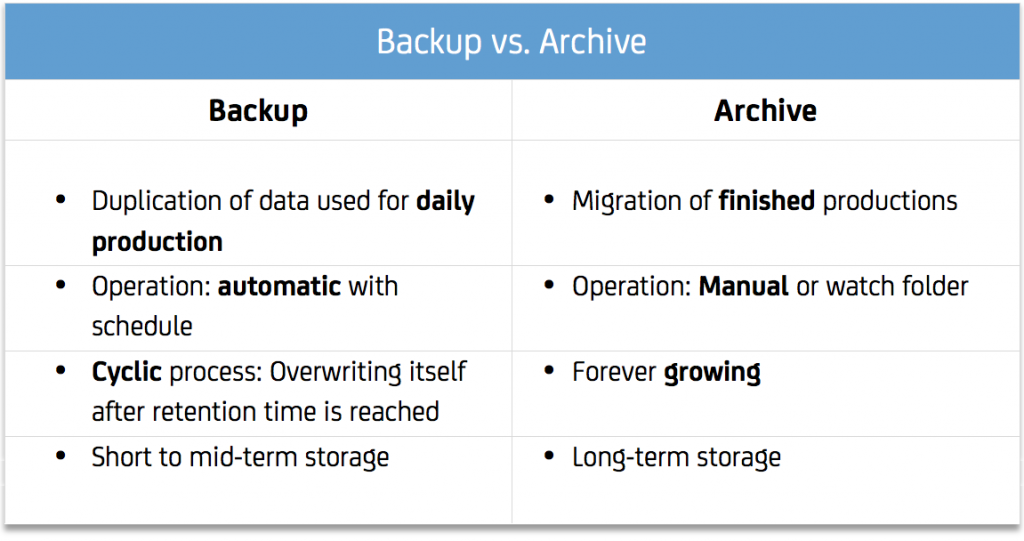
Archive Is Not Backup
One reason organisations struggle with storage growth is that backup and archive are often treated as the same thing.
They are not.
Products like P5 Backup protect active data against accidental deletion, corruption, ransomware, or hardware failure. They are designed to recover information that is still being worked on.
Products like P5 Archive serve a different purpose. They move completed, inactive content out of the production environment while preserving the ability to find and restore it when required.
An organisation may have excellent backups and still suffer from chronic storage shortages because backup systems do not solve the problem of inactive data occupying valuable production capacity.
In fact, retaining inactive data online can make backup systems larger, slower, and more expensive than they need to be.
Creating Space Without Buying More Storage
This is where archive becomes strategically important.
By identifying completed projects and moving them to long-term archive storage, organisations can immediately reclaim significant amounts of production capacity.
For many media organisations, this process does not require complex workflow changes.
A typical archive workflow is straightforward:
A completed project is selected for archive. The project is written to archive storage, verified, and indexed. Once the archive copy has been confirmed, the primary storage copy can be removed.
The result is immediate capacity recovery without purchasing additional disks, expanding storage systems, or migrating infrastructure.
Importantly, the content has not disappeared. It remains searchable and recoverable should it be needed in the future.
The objective is not to make data inaccessible. The objective is to store it in the most appropriate place based on how frequently it is used.
Why LTO Continues to Make Sense
For long-term media retention, LTO remains one of the most practical archive technologies available.
Unlike online storage systems, LTO does not consume power while sitting on a shelf. It provides protection against ransomware because archived tapes can be physically disconnected from the network. It offers predictable long-term storage costs and avoids the recurring fees associated with keeping large datasets permanently online.
Most importantly, LTO is designed for content that must be retained but does not need to remain on expensive production storage.
This makes it particularly attractive for media organisations seeking to balance retention requirements with storage budgets.
The Importance of Simple Archive Software
Historically, one obstacle to archive adoption has been complexity.
Many organisations understood the value of archiving but lacked the resources or expertise to implement a practical workflow. Archive systems were often viewed as specialist tools requiring dedicated operators.
Modern archive software has changed that perception.
Solutions such as Archiware P5 Archive provide searchable archive indexes, automated archive workflows, and straightforward retrieval processes through a web-based administration interface. Content can be archived, tracked, located, and restored without requiring users to manage the underlying storage media directly.
The technology becomes a shared operational tool rather than a specialised project.
A Crisis That Creates an Opportunity
The current HDD and SSD shortage has created a compelling business case for archiving that may not have existed previously.
When additional storage was inexpensive and readily available, archive projects often struggled to gain management attention. Today, the discussion is different.
Storage expansion may be delayed. Budgets may be constrained. Procurement may be more difficult.
Under these conditions, archiving becomes more than a compliance requirement or a nice-to-have. It becomes an immediate method of creating capacity and improving operational efficiency.
The shortage has not changed the fundamental economics of storage management. Archiving was always the more efficient approach for inactive data.
What has changed is that organisations now have a clear reason to act.
For media and entertainment companies facing growing storage demands, the most effective response may not be buying more storage at all. It may be finally implementing the archive strategy they should have adopted years ago, one that will outlive the passing crisis.

